Ways to Make Your Retirement Savings More Tax Efficient in Wisconsin
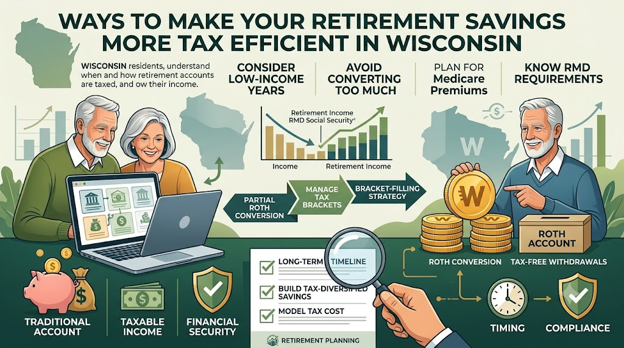
Retirement savings can provide financial security, but taxes can affect how much money you actually keep during retirement. For Wisconsin residents, understanding when and how retirement accounts are taxed can help create a more flexible long-term plan.
One strategy worth understanding is a
Roth conversion, which moves money from a traditional retirement account into a Roth account and requires taxes to be paid on the converted amount in the year of conversion. The goal is to manage taxes over time instead of facing a larger tax burden later.
Understand How Retirement Accounts Are Taxed
Traditional retirement accounts can create taxable income when money is withdrawn during retirement. Contributions to these accounts may have been made before taxes, but withdrawals are generally treated as ordinary income. This can become more important later in retirement when required withdrawals begin.
Understanding this difference can help you think about how your savings may be taxed in different stages of retirement.
- Traditional accounts generally create taxable income when withdrawals are made.
- Roth accounts can provide tax-free withdrawals when applicable requirements are met.
- Required Minimum Distributions from traditional accounts begin at age 73.
- Roth accounts do not have Required Minimum Distributions during the owner's lifetime.
Having different types of retirement accounts can therefore give you more flexibility when deciding where to take money from each year.
Consider a Roth Conversion During Lower-Income Years
A Roth conversion involves moving money from a traditional IRA or 401(k) into a Roth IRA. The amount converted is added to your taxable income for that year, meaning you pay ordinary income tax on the conversion.
However, once the money is in the Roth account, future growth and qualifying withdrawals can be tax-free. This makes timing an important part of tax-efficient retirement planning in Wisconsin.
A lower-income year may provide an opportunity to consider a conversion. For example, some people have a period after retirement and before Social Security or required retirement distributions begin when their taxable income is lower than it may be later.
During such a period, converting part of a traditional account may allow you to pay taxes at a lower current rate rather than potentially paying more later.
Avoid Converting Too Much at Once
A Roth conversion does not automatically make sense simply because future withdrawals can be tax-free. The amount converted matters because the conversion increases taxable income for the year.
A large conversion could move you into a higher tax bracket and create a larger tax bill than expected. Because of this, converting smaller amounts over several years may be more suitable than moving the entire balance at one time.
Consider these points before choosing the amount:
- Review your expected taxable income for the year.
- Consider how much of your current tax bracket you want to use.
- Compare a partial conversion with a full conversion.
- Look at the possible effect on your future retirement income.
- Model the tax cost before completing the conversion.
The idea is to manage the conversion amount carefully rather than treating the entire retirement account as one amount that must be converted immediately.
Use Partial Conversions to Manage Tax Brackets
Partial Roth conversions can help spread the tax impact across multiple years. Instead of converting a large retirement balance in one year, you may convert an amount that fits within a desired tax bracket.
This approach is sometimes called bracket-filling. The goal is to use available room in a lower tax bracket without unnecessarily moving into the next one.
For someone considering
tax-efficient retirement planning in Wisconsin, this can be an important part of evaluating how much to convert and when to convert it.
| Conversion approach | Main tax consideration | Potential planning benefit |
|---|---|---|
| Large conversion | May create a higher taxable income in one year | Moves more money into the Roth account sooner |
| Partial conversion | Spreads taxable income across years | Can help manage annual tax exposure |
| Conversion during a lower-income year | Current taxable income may be lower | May make the tax cost easier to manage |
The right approach depends on individual income, retirement accounts, timing, and long-term goals.
Consider the Effect on Medicare Premiums
Taxes are not the only factor that can change when taxable income increases. A large Roth conversion can also affect Medicare premiums for eligible individuals.
Medicare Part B and Part D premiums are based on income from two years earlier. A calculation known as IRMAA can result in higher premiums when income reaches certain levels.
This means a conversion that looks reasonable based only on the immediate tax bill may have other financial effects later.
Before converting, consider:
- Your expected income for the conversion year.
- Whether you are already receiving Medicare.
- How much the conversion could increase your reported income.
- Whether the higher income could affect future Medicare premiums.
Considering these factors can help provide a more complete view of the cost of a conversion.
Keep Money Available to Pay the Conversion Tax
Taxes on a Roth conversion need to be considered before the conversion is completed. Ideally, the taxes are paid using savings outside the retirement account rather than taking the tax amount directly from the converted funds.
Using retirement funds to pay the tax reduces the amount that remains in the Roth account. That means less money is available for potential tax-free growth.
Having enough non-retirement savings to cover the tax can therefore make the conversion more effective. Before making a decision, it is important to look at both the retirement account balance and available cash outside retirement accounts.
Think About Your Long-Term Retirement Timeline
The amount of time you have before needing the converted money can influence whether a Roth conversion makes financial sense. The tax benefit generally needs time to outweigh the upfront tax cost.
If the converted funds remain invested for many years, there may be more time for tax-free growth to become valuable. The website notes that having ten or more years before needing the funds can often make the conversion mathematics more favorable.
On the other hand, if you expect to need the money within only a few years, paying the tax today may not provide enough time for the potential benefits to outweigh that initial cost.
Consider Future Required Minimum Distributions
Required Minimum Distributions can become an important part of retirement tax planning. Traditional IRAs and 401(k)s are subject to required withdrawals beginning at age 73.
These withdrawals increase taxable income and may potentially affect tax brackets, Medicare premiums, and the taxability of Social Security benefits.
Converting some traditional retirement savings to a Roth account before Required Minimum Distributions begin can reduce the amount remaining in traditional accounts. As a result, future required withdrawals may be lower.
Roth accounts also do not have Required Minimum Distributions during the owner's lifetime. This can provide additional flexibility when managing retirement income over time.
Build a Mix of Taxable and Tax-Free Retirement Savings
Keeping all retirement savings in one type of account can limit your choices later. A combination of taxable, tax-deferred, and tax-free accounts can provide greater flexibility.
Different account types can give you different options when deciding where to take retirement income in a particular year. For example, having Roth savings may allow you to use tax-free retirement funds when taking additional money from a traditional account could create more taxable income.
This type of tax diversification can be useful because your income and tax situation may change throughout retirement. Instead of relying on one account type, a balanced approach can provide more choices when managing withdrawals.
Review the Strategy Before Making a Conversion
A Roth conversion should be modeled before it is completed because the best decision depends on personal circumstances. Income, retirement account balances, timing, cash available for taxes, and the expected need for the money can all affect the outcome.
Before making a decision, review:
- Your current and expected future taxable income.
- The amount you may want to convert.
- Your available savings for paying conversion taxes.
- The time before you expect to use the converted funds.
- The possible effect on Medicare premiums and other retirement income.
A careful review can help you understand whether a partial conversion, a larger conversion, or waiting for another year may better fit your situation.
Conclusion
Making retirement savings more tax-efficient is mainly about understanding when taxes may apply and planning before major retirement income decisions are made. Roth conversions can shift some money from tax-deferred accounts into a Roth account, but the conversion itself creates taxable income.
Lower-income years, partial conversions, available cash for taxes, long-term timelines, and future Required Minimum Distributions are important factors to consider. A thoughtful approach can help create greater flexibility across retirement accounts while reducing the risk of unexpected tax costs during retirement.
Recent Posts